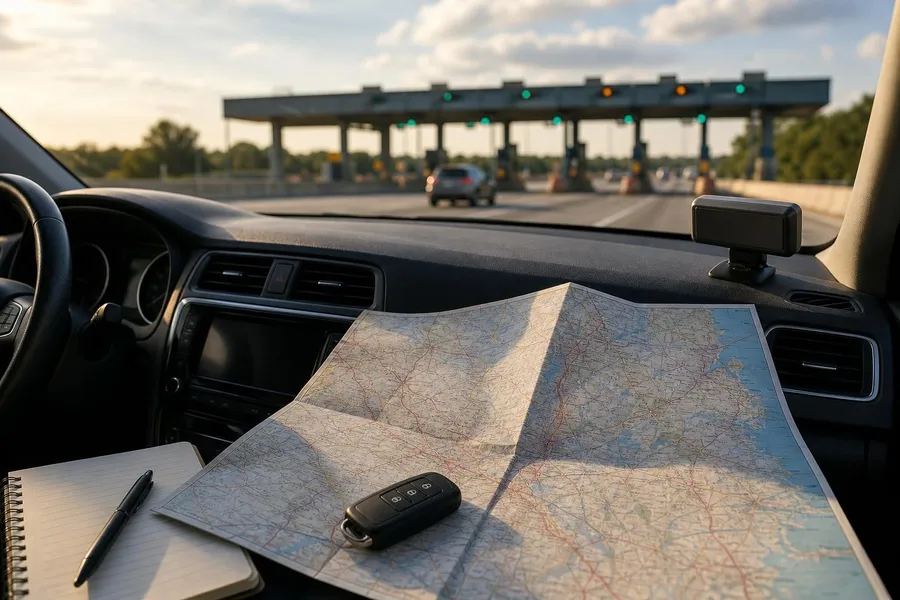
What is a toll pass? A toll pass is an electronic account, transponder, or license-plate billing setup that lets you pay highway, bridge, tunnel, and express-lane tolls without stopping for cash. On a U.S. road trip, a toll pass pays off when it costs less than cashless toll invoices, rental-car toll programs, convenience fees, and the time lost avoiding tolled routes. The right answer depends on where you drive, whether you rent, how many tolls you expect, and whether your pass works across state lines. This guide explains the math, the rental-car traps, and the practical steps to choose a pass before a long drive.
A toll pass is usually worth it if your route includes several cashless tolls, major metro areas, bridges, tunnels, or express lanes.
Rental cars change the math because tolls may trigger daily service fees, all-inclusive toll plans, or post-rental charges weeks later.
Interoperability matters: E-ZPass, SunPass PRO, E-PASS Uni, FasTrak, Good To Go!, TxTag, and other systems do not all work everywhere.
The breakeven point is reached when toll discounts plus avoided rental or invoice fees exceed the cost and effort of getting the pass.
When does a toll pass pay off?
A toll pass pays off when it reduces either your direct cost, your risk of extra fees, or your travel friction. In many parts of the United States, toll booths have been replaced by all-electronic tolling. If you do not have a compatible pass, the toll agency may bill the vehicle owner by license plate. In your own car, that invoice usually comes to you. In a rental car, it often goes first to the rental company or a toll administrator, which may add fees under the rental agreement.
The basic formula is simple: compare the cost of the pass, prepaid balance, and any account fees against the money saved on discounted toll rates and avoided administrative charges. The less obvious factor is route flexibility. A pass can make it reasonable to use a faster toll road into Orlando, a bridge in the Bay Area, an express lane near Seattle, or a tunnel in the Northeast without stopping to figure out payment rules at the last minute.
A practical breakeven formula
Use this quick calculation before your trip: expected toll savings + avoided fees - pass cost = net benefit. For example, if a portable pass costs about $15, and using it avoids two or three rental-car toll service days, the pass may pay for itself quickly even before considering any discounted toll rates. If you will cross only one low-cost bridge in your own car and can pay online without a penalty, a new pass may not be worth the trouble.
Trip situation | Toll pass decision | Why it matters |
|---|---|---|
One short toll segment in your own car | Usually optional | Online or pay-by-plate options may be enough if there are no added fees. |
Multi-state Northeast drive | Often worth it | E-ZPass coverage is broad across many bridges, tunnels, and turnpikes. |
Florida vacation with a rental car | Often worth it | SunPass-compatible transponders can avoid rental-program charges when set up correctly. |
California rental with one bridge crossing | Maybe not | A short-term license plate account may be simpler than buying a transponder. |
Seattle-area toll roads and express lanes | Worth checking | Good To Go! accounts can reduce pay-by-mail costs and simplify visitor tolls. |
How cashless toll roads change the cost
Cashless tolling is convenient, but it removes the old fallback of paying a booth attendant. If you miss a toll in an all-electronic system, the road operator normally uses cameras to identify the license plate. That can be fine in your own vehicle if your registration address is current and you pay the invoice on time. It can become expensive if the bill goes to a rental fleet owner, if the toll authority adds a higher pay-by-plate rate, or if a late notice turns into a violation.
Some states make the difference explicit. In Texas, TxDOT notes that its toll roads are collected electronically and that drivers without a toll tag are charged higher rates. In Washington, Good To Go! accounts can be set up for visitors, and a temporary account can reduce the cost compared with pay by mail. These differences are often small per toll but add up on a long route with repeated crossings.
Costs that are easy to overlook
Pay-by-plate rates that are higher than transponder rates.
Administrative fees from rental-car toll vendors.
Late fees if a mailed invoice goes to an old address or to the rental company first.
Express-lane rules that require a special switchable transponder for carpool discounts.
Toll charges that post after the trip, making receipts harder to reconcile.
Rental cars: when the toll pass is really about avoiding fees
Rental cars are where toll math changes fastest. Many rental companies offer a toll product that lets you drive through electronic toll lanes and pay later. That convenience may be useful, but it can also turn a few dollars in tolls into a much larger bill if daily fees apply. The key is to read the toll section of the rental agreement before leaving the counter, especially in Florida, Texas, California, the Northeast, and around major airports.
For example, Avis e-Toll describes an unlimited option with a daily flat fee that varies by checkout location, plus rules for standard e-Toll use. Hertz PlatePass states that customers who decline the all-inclusive service but still use electronic toll roads may be charged tolls at the highest undiscounted applicable rate plus a usage-day fee. Enterprise’s TollPass materials describe a usage fee plus the cost of tolls. Exact amounts can change, so the current rental agreement controls.
When the rental company’s toll plan can make sense
You will use toll roads on most rental days and want predictable billing.
You are driving in an unfamiliar metro area with many cashless toll points.
Your employer reimburses the rental toll product and the receipt is easy to submit.
You cannot reliably set up your own compatible pass before the trip.
When your own pass is usually better
Your own pass is often better when the rental company charges for each rental day, when your actual toll use is limited to one or two days, or when you already have a compatible device. In Florida, SunPass explains that prepaid customers can add a rental vehicle’s license plate and rental date range to their account. In the Bay Area, FasTrak lists options such as using your own toll tag or setting up a short-term license plate account. The setup step is not optional: if the plate, dates, or transponder are wrong, charges can route to the rental company instead.
Which U.S. toll pass should road trippers consider?
There is no single national toll pass that works on every toll road in the United States. The best choice depends on the region. E-ZPass is the dominant system across much of the Northeast, Mid-Atlantic, and parts of the Midwest. Florida has SunPass and E-PASS. California uses FasTrak statewide. Washington uses Good To Go!. Texas has multiple interoperable tags, including TxTag, TollTag, and EZ TAG, with additional acceptance of some out-of-state tags on specific facilities.
For cross-country or snowbird routes, a broad-coverage portable transponder can be useful. SunPass PRO is designed to work in Florida plus many E-ZPass states and several other participating states. E-PASS Uni is another multi-state option from the Central Florida Expressway Authority. Still, always check your exact roads before relying on any pass, because acceptance can vary by facility, vehicle class, express lane, and discount program.
Pass or system | Best for | Road-trip caution |
|---|---|---|
Northeast, Mid-Atlantic, and many Midwest toll routes | Discounts can depend on the issuing agency, not just E-ZPass acceptance. | |
Florida plus many Eastern and Central toll states | Do not confuse it with older or more limited SunPass products. | |
Florida travelers who also drive in E-ZPass regions | Confirm current state coverage and account setup before departure. | |
California toll bridges, toll roads, and express lanes | Not a national pass; rental plates should be added only for the rental period. | |
Washington state toll roads, bridges, tunnels, and express toll lanes | Carpool benefits may require a specific pass type, not just plate billing. |
How to decide before you leave home
The best time to choose a toll strategy is before you book the rental car or finalize your route. Toll rules are local, and navigation apps may route you onto tolled express lanes without showing the full payment implications. A few minutes of planning can prevent a surprise charge a month later.
Map the likely toll zones. Look for toll roads, managed lanes, airport access roads, bridges, tunnels, and express lanes along the route.
Check pass acceptance. Confirm that your pass works on the exact facility, not just in the state generally.
Compare rental fees. Read the toll section for daily fees, unlimited plans, usage-day fees, and billing timing.
Set up plates and dates. If using your own account with a rental, add the license plate, state, start date, and end date as soon as you pick up the car.
Save proof. Keep screenshots of the rental plate setup, toll account activity, and rental agreement until all tolls have posted.
A simple rule of thumb
If you will be in a rental car for a week and use toll roads on only one day, a rental-company all-inclusive daily plan may be poor value. If you will drive toll roads every day in Orlando, Miami, New York, New Jersey, Dallas, Houston, Chicago, or around Washington, D.C., a compatible pass or a well-priced rental toll product can be worthwhile. If you are in your own vehicle and already have an interoperable transponder, the pass is usually the easiest option as long as your account has funds and your plate is current.
Common mistakes that lead to surprise toll bills
Most surprise toll bills come from small setup errors, not from the toll itself. The most common mistake is assuming a pass works everywhere because it worked in a neighboring state. Another is adding a rental plate without an end date, which can leave your account responsible for tolls after you return the car. The opposite mistake is failing to add the rental plate at all, especially when the transponder does not read and the system falls back to the license plate.
Leaving the rental company’s transponder active while also using your own pass.
Forgetting to fund a prepaid account before entering a toll road.
Using a sticker transponder that cannot be moved from one windshield to another.
Assuming express-lane carpool discounts apply automatically.
Ignoring toll emails or mailed invoices because the trip already ended.
FAQ
Is a toll pass worth it for one U.S. road trip?
It can be worth it if the trip includes several cashless tolls, a rental car, or metro areas where pay-by-plate and rental toll fees are common. For one minor toll in your own car, online payment may be enough.
Can I use my own toll pass in a rental car?
Often yes, but only if the pass is compatible and the toll agency or pass issuer allows rental vehicles. Add the rental plate and date range to your account when required, and remove it after the rental.
Do rental-car toll plans include the actual tolls?
It depends on the company and plan. Some are all-inclusive daily products, while others charge the actual tolls plus a convenience or usage fee. The rental agreement is the controlling document.
What happens if I drive on a cashless toll road without a pass?
The toll agency typically bills by license plate. In your own car, the bill may come to you. In a rental car, it may go to the rental company or toll administrator, which can add fees.
Does E-ZPass work everywhere in the United States?
No. E-ZPass has broad coverage in many Eastern and Midwestern states, but it is not accepted on every U.S. toll road. California, Washington, and some other regions use different systems.
What is the best toll pass for Florida rental cars?
A Florida-compatible pass such as SunPass, SunPass PRO, or E-PASS may work well if it is set up correctly with the rental vehicle. SunPass PRO and E-PASS Uni can be useful for travelers who also drive in E-ZPass regions.
Should I buy the rental company’s unlimited toll option?
Consider it if you will use toll roads on most rental days and want predictable billing. Skip or compare it carefully if you expect only one or two toll days, because daily charges can exceed the tolls themselves.
How long should I keep toll records after a trip?
Keep toll account screenshots, rental agreements, and receipts until all toll charges have posted and your credit card statement is final. Rental toll charges can appear after the vehicle is returned.
Conclusion: choose the toll strategy before the first gantry
A toll pass pays off on a U.S. road trip when it prevents higher pay-by-plate rates, avoids rental-car service fees, and makes the fastest route easier to use. The best choice is not always the most expensive pass or the rental company’s unlimited plan. It is the option that matches your exact route, vehicle, and number of toll days.
For your own car, make sure your account is funded, your plate is current, and your pass is accepted on the roads you plan to use. For a rental, decide before pickup whether you will use the rental toll plan, your own portable transponder, a temporary license plate account, or toll-free routes. The biggest savings often come from avoiding confusion: set up the right account, keep proof, and remove the rental plate when the trip ends.
Sources
E-ZPass Group official information on E-ZPass participation and toll facility acceptance.
SunPass official SunPass PRO and rental vehicle guidance.
Bay Area FasTrak rental vehicle and short-term license plate account guidance.
Washington State Department of Transportation Good To Go! account, pass, visitor, and rental car information.
Avis official e-Toll service terms and rental toll billing information.