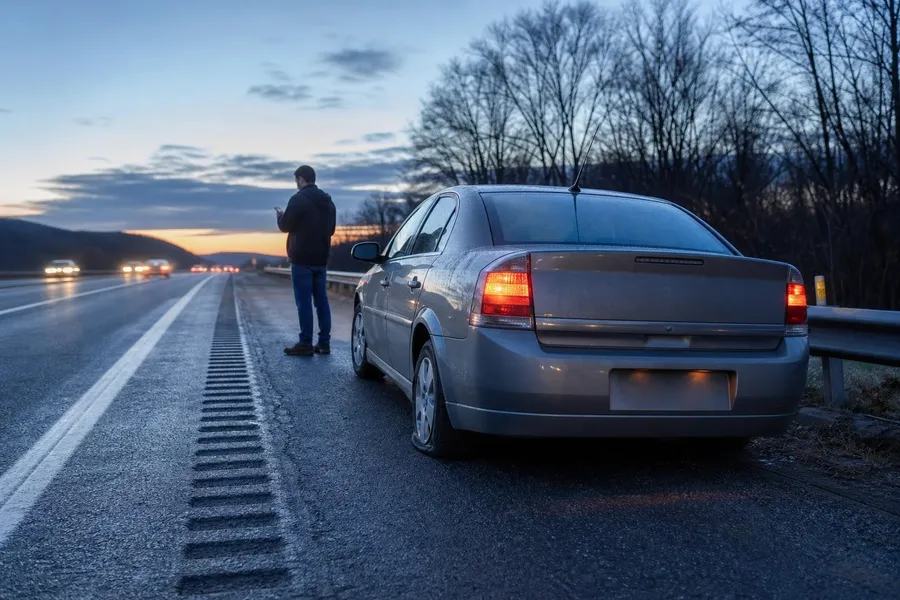
What is a flat tire on the highway? A flat tire on the highway is a tire failure that happens while your vehicle is moving in fast traffic, often at speeds of 55 mph or higher, and it requires safety decisions before repair decisions. The safest next steps are to stay calm, keep control of the vehicle, move out of travel lanes if you can do so without sudden steering or braking, turn on your hazard lights, and call for help from a safer location. This guide explains how to handle a flat tire on the highway, when to stay inside the vehicle, when not to change the tire yourself, what to tell roadside assistance, and how to prepare so a tire emergency is less dangerous.
Quick summary
Do not slam on the brakes. Ease off the accelerator, hold the steering wheel firmly, and slow gradually.
Aim for a safer stopping point. A wide right shoulder, exit ramp, rest area, parking lot, or well-lit service area is usually safer than a narrow shoulder.
Make the vehicle visible. Turn on hazard lights, keep exterior lights on at night, and use warning triangles or flares only if you can deploy them safely.
Do not change a tire next to high-speed traffic. If traffic is close, the shoulder is narrow, visibility is poor, or the flat is on the traffic side, call roadside assistance or 911 if there is an immediate hazard.
Give helpers a precise location. Share the highway name or number, direction of travel, nearest exit, mile marker, cross street, and vehicle description.
First seconds: how to control the car after a blowout or sudden flat
A sudden flat can feel like the vehicle is pulling hard to one side, vibrating, thumping, or losing steering response. Your first job is not to save the tire. It is to keep the vehicle predictable for other drivers. Grip the steering wheel with both hands, keep the vehicle moving in a straight line, and avoid overcorrecting. A sharp turn can cause a loss of control, especially in an SUV, pickup, van, or heavily loaded car.
Take your foot off the accelerator and let the car slow down gradually. If braking is necessary, use light, steady pressure. Heavy braking can shift weight suddenly and make the damaged tire harder to control. Activate your hazard lights as soon as you can do so without looking away from the road for too long.
If the vehicle remains controllable, signal and work your way toward the right shoulder or the nearest exit. Do not cut across lanes in panic. If you are already in a left lane on a divided highway and the right side is not safely reachable, a wide left shoulder may be the safer temporary choice. The priority is to get out of active traffic without creating a second emergency.
Where should you stop with a flat tire on the highway?
The safest stopping place is one that separates you from moving traffic and gives a tow truck or roadside technician room to work. A wide shoulder is better than a narrow one, and an exit ramp, rest area, gas station, or parking lot is usually better than any shoulder. If you can drive a short distance at very low speed to reach a safer place, that may be reasonable, but only if the vehicle remains controllable and you are not shredding debris across the road.
Driving on a flat can damage the wheel, suspension, brake components, and tire pressure monitoring equipment. Still, there are situations where moving a few hundred yards to avoid high-speed traffic is safer than stopping immediately in a dangerous spot. Choose personal safety over the cost of a wheel.
Stopping option | Safety level | Best use |
|---|---|---|
Exit ramp or rest area | Highest | Use when the car is controllable and an exit is close. |
Wide right shoulder | Moderate to high | Use when you can get completely out of the travel lane with space on the passenger side. |
Narrow shoulder | Low | Use only if the vehicle cannot safely continue and traffic lanes are clear of your car. |
Travel lane | Dangerous | Call 911 immediately if the car is stopped in a lane or is creating a crash risk. |
Should you stay in the car or get out?
There is no one-size-fits-all answer because the safer choice depends on location, traffic speed, visibility, weather, and whether there is a barrier or safe area nearby. If your vehicle is completely off the roadway and there is no safe place to stand away from traffic, remaining inside with your seat belt fastened may be safer than standing on the shoulder. Keep hazard lights on and wait for professional help.
If the vehicle is in or partly in a traffic lane, if smoke or fire is present, if you smell fuel, or if you are in another immediate danger, get everyone out only when it is safe to do so. Exit from the side away from traffic, move behind a guardrail if available, and stay well away from the front or rear of the vehicle. Never stand between your car and traffic, and never stand directly behind the vehicle where another driver might drift onto the shoulder.
When 911 is appropriate
Call 911 if the disabled vehicle is blocking a lane, you cannot move out of traffic, someone is injured, you see fire or smoke, there is a crash, you are stranded in an unsafe location, or you feel threatened. If the vehicle is safely off the road and nobody is injured, roadside assistance, your insurance assistance line, a towing company, or a state highway assistance patrol may be the better first call.
How to make your vehicle visible while you wait
Visibility reduces the chance that another driver will notice your car too late. Turn on hazard lights immediately. At night, keep parking lights or low beams on if doing so will not drain the battery before help arrives. If you have reflective triangles, LED beacons, or flares, use them only if you can place them without walking close to traffic.
Place warning devices behind the vehicle far enough to give approaching drivers time to react, but do not risk your life to set them out on a busy highway. On curves, hills, bridges, construction zones, heavy rain, fog, or snow, visibility can change quickly. In those situations, calling for professional assistance and staying away from moving traffic is more important than attempting a roadside repair.
Turn on hazard lights before you begin moving to the shoulder, if practical.
Put on a reflective vest before exiting, if you have one.
Use a flashlight at night, but avoid shining it into the eyes of oncoming drivers.
Do not stand in the roadway to wave traffic around your vehicle.
If conditions are unsafe, wait for law enforcement, highway assistance, or a tow operator.
Should you change the tire yourself on the highway?
Changing a tire on a highway shoulder is often more dangerous than the flat tire itself. You should only attempt it if the vehicle is well off the road, the ground is firm and level, traffic is not close, visibility is good, you have the correct tools, and the flat tire is not on the side facing traffic. If any of those conditions are missing, wait for help.
Before touching the spare, read the vehicle owner’s manual if you are unfamiliar with the jack points or spare tire system. Many vehicles use temporary spare tires with speed and distance limits. Some newer cars do not include a spare at all and instead provide a sealant kit, inflator, or run-flat tires. These systems have limits, especially if the tire sidewall is damaged or the tire has separated.
Minimum conditions for a roadside tire change
The vehicle is completely out of traffic with several feet of clearance from moving vehicles.
The flat tire is on the side away from traffic, or there is enough space to work safely.
The surface is firm, flat, and not sloped, soft, icy, or muddy.
You have a usable spare, jack, lug wrench, wheel lock key if required, and enough lighting.
You can complete the work without stepping into a live lane or turning your back to traffic for long.
What to tell roadside assistance or a tow company
A clear call saves time and reduces confusion. Start with your location, then the safety status. For location, give the interstate or highway number, direction of travel, nearest exit, mile marker, cross street, or landmark. Smartphone maps can help, but road direction matters. Saying "I am on I-95 northbound, just past Exit 42, on the right shoulder" is more useful than sending a pin without context.
Next, describe the vehicle and the problem: color, make, model, license plate state, whether the tire is shredded or simply low, whether you have a spare, and whether the wheel lock key is available. Tell the dispatcher if children, older adults, pets, medical needs, extreme heat, extreme cold, or poor visibility are involved. If traffic is close or the vehicle is partly in a lane, say that first.
Useful script: I have a flat tire on the highway. I am safely off the road on the right shoulder, or I am blocking a lane. My location is highway, direction, exit or mile marker. My vehicle is color, make, and model. I have or do not have a usable spare.
Common mistakes that make a highway flat tire more dangerous
The biggest mistake is treating the situation like a driveway repair. Highway traffic creates wind, noise, low reaction time, and distracted drivers. Even experienced drivers and mechanically skilled people can be at risk when they crouch beside a vehicle only a few feet from traffic.
Stopping too soon in a bad spot. If the car is controllable, look for a wider shoulder, exit, or safer pull-off.
Standing behind the vehicle. A stopped car can be struck from behind, especially at night or in poor weather.
Changing the traffic-side tire. If the flat is on the left side next to passing vehicles, call for help.
Using the wrong jack point. This can damage the vehicle or cause it to fall from the jack.
Driving normally on a temporary spare. Follow the tire and vehicle instructions, and go directly to a repair shop.
What to keep in your car for a safer tire emergency
A roadside kit cannot make a shoulder safe, but it can help you stay visible, communicate, and wait more comfortably. The National Highway Traffic Safety Administration and Ready.gov both recommend keeping emergency supplies in the vehicle. For tire situations, the most useful items are the ones that help you call for help, warn other drivers, and avoid improvising with unsafe tools.
Item | Why it matters |
|---|---|
Phone charger or power bank | Lets you call 911, roadside assistance, insurance, or family while waiting. |
Reflective vest and warning triangles | Improves visibility if you must exit the vehicle or warn traffic from a safe location. |
Flashlight or headlamp | Helps you see tools, damage, mile markers, and your surroundings at night. |
Tire pressure gauge | Helps identify underinflation before a long trip and confirm spare tire condition. |
Jack, lug wrench, and wheel lock key | Essential if a tire change is safe and your vehicle is equipped for one. |
Water, medication, blanket, and basic first aid | Useful if help is delayed, especially in heat, cold, or remote areas. |
How to reduce the chance of a highway flat tire
Many flat tires cannot be predicted, but basic tire care lowers risk. Check tire pressure when tires are cold, especially before highway trips, after large temperature swings, or when carrying extra passengers and luggage. Use the pressure listed on the driver-side door placard, not the maximum pressure printed on the tire sidewall.
Inspect tread depth and look for cuts, bulges, exposed cords, nails, uneven wear, or cracking. Uneven wear can point to alignment, suspension, or inflation problems. If your tire pressure monitoring light comes on, do not ignore it. Find a safe place to check the tires and add air if appropriate. A slow leak at city speeds can become a dangerous failure at highway speeds.
Before a road trip, confirm that your spare tire, inflator kit, or run-flat system is actually usable. Temporary spares can lose air over time, and sealant kits can expire. If you drive a used car, rental car, or newly purchased vehicle, verify what equipment is in the trunk before you need it.
Questions and answers about a flat tire on the highway
Is it safer to drive on a flat tire to the next exit?
Sometimes, but only for a short distance and at very low speed if the vehicle remains controllable and the next exit or wider shoulder is close. Personal safety is more important than wheel damage, but do not drive normally on a flat tire.
Should I call 911 for a flat tire?
Call 911 if your vehicle is in a travel lane, partly blocking traffic, involved in a crash, smoking, on fire, or in a location where you or others are in immediate danger. If you are safely off the road, call roadside assistance or a tow provider.
Can I change a tire on the left shoulder of an interstate?
Only if there is a very wide shoulder, excellent visibility, and enough distance from traffic. In most cases, a left-side tire change near fast traffic is too risky and should be handled by professionals.
What if my car does not have a spare tire?
Call roadside assistance, your insurer’s assistance line, or a tow company. Some vehicles have a sealant and inflator kit or run-flat tires, but those options may not work for sidewall damage, large punctures, or a shredded tire.
Should passengers get out of the car?
If the vehicle is safely off the road and there is no safer place behind a barrier, passengers may be safer belted inside. If the vehicle is in danger of being hit, on fire, or otherwise unsafe, exit away from traffic when it is safe and move to a protected area.
How can I help a driver with a flat tire on the highway?
Do not stop in a dangerous spot or walk along high-speed traffic. If you can safely call 911 or highway assistance for a vehicle blocking traffic, do so. If you stop, pull far ahead in a safe area and avoid standing near traffic.
How fast can I drive on a temporary spare tire?
Follow the instructions on the spare tire and in the owner’s manual. Many temporary spares have strict speed and distance limits, and they are meant to get you to a repair facility, not to continue a normal trip.
Will insurance pay for towing after a flat tire?
It depends on your policy and whether you have roadside assistance coverage. Some auto insurance policies, credit cards, vehicle warranties, and motor clubs include towing or tire-change benefits, while others require out-of-pocket payment in USD.
Conclusion
A flat tire on the highway is a safety problem first and a repair problem second. The safest approach is to keep control, slow gradually, move out of traffic, make the vehicle visible, and call for help when conditions are unsafe. Do not let embarrassment, impatience, or concern about repair cost push you into changing a tire beside fast-moving traffic.
Prepare before you need it: know where your spare or inflator kit is, keep a roadside kit in the car, maintain proper tire pressure, and understand your roadside assistance options. If you are ever unsure, choose the safer waiting position and let trained responders handle the roadside work.
Sources
National Highway Traffic Safety Administration: Summer Driving Tips and roadside emergency kit guidance
National Highway Traffic Safety Administration: Move Over: It’s the Law
Ready.gov: Car Safety and emergency vehicle kit recommendations
National Safety Council: Stranded vehicle safety guidance